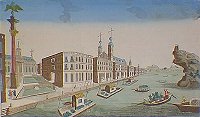
"Vue de la Ville du Mexique prise du coté
du
Lac."
(Mexico City as imagined by eighteenth century
Europeans.)
Humanities and the European Background
Middle Ages (500-1500 A.D.):
- Begins with collapse of Western Roman Empire (See
Timelines
 )
)
- Ends with "discovery" of Western Hemisphere,
- Invention of printing press (1455: Gutenberg Bible),
- Break in the religous unity through Protestant
Reformation, and
- Renewal of direct contact with Greek Art, Thought, and
Literature
Terms to Know:
- Lyric: "a brief subjective
poem
strongly
marked by imagination, melody, and emotion, and creating a
single,
unified
impression" (H&H 283).
- Petrarchan Conceit: used in
his
love sonnets,
widely imitated or ridiculed by Renaissance English
sonneteers. Used
"elaborate
and exaggerated comparisons expressing in extravagant terms
the beauty,
cruelty, and charm of the Beloved and the suffering and
despair of the
forlorn Lover. . . . Oxymoron is common" (H&H 370).
- Oxymoron: an expression in
which
the two
parts appear to contradict or be incompatible. i.e.
jumbo shrimp,
bittersweet, sweet sorrow, military intelligence (not widely
accepted
as
such).
- Sonnet: Lyric poem of
14 lines
with
one of various rhyme schemes (pattern of end
rhyme).
- Petrarchan (Italian):
Octave
abba abba & Sestet cde cde or cd cd cd
- "Octave presents a narrative, states a proposition,
or
raises a question;
the Sestet drives home the narrative by making an abstract
comment,
applies
the proposition, or solves the problem" (H&H 476).
- Shakespearean (English):
3
Quatrains
abab cdcd efef, 1 Rhymed Couplet gg
- "Structurally, the three quatrains prepare the reader
for
the couplet
that ends the sonnet. They present a situation, ask
a question,
deliver
a meditation on beauty, change, or time, or identify a
problem.
The
result of the meditation, the resolution to the conflict
contained in
the
situation, the answer to the question, or the problem's
solution, is
given
in the ending couplet" (Roland 422).
Homework Questions:
"Humanities Today"
xxv:
- According to the editors, from where do the Humanities
arise?
xxvi:
- In describing the emergence of a "modern" American
culture,
Jackson
says, "On the one hand, the emerging civilizations became
'melting
pots.'
On the other hand, the issues of race and class arising from
colonial
contacts
continue powerfully" (xxvi). What does this mean?
What is a
melting pot? Is it a good or a bad thing?
- What other developments, especially in terms of
explaining the
world,
characterized the movement into "the Modern"?
"European Background"
411:
- When did the Medieval Period occur?
- When did the Renaissance begin?
- What characterized the transition?
412:
- Describe the historical significance of the inventions of
the printing press and gunpowder.
- Explain the significance of the inventions of the telescope
and microscope.
- Who were the Humanists? What did they believe?

Francesco Petrarch (1304-1374)
- During which historical period did he live?
601:
Sonnet #3: "It Was the Morning of That Blessed Day" (Go to
Poem )
602:
- What is "that blessed day"(1)?
- What is "the constant gate and fountain of my grief"
(12)?
- Does this fit the criteria for a Petrarchan Sonnet?
A
Petrarchan
Conceit? Explain.

William Shakespeare (1564-1616)
- During which historical period did he live?
Sonnet #18: "Shall I Compare Thee to a Summer's Day?" (Go
to
Poem )
606:
- Which Sonnet type does this most resemble? Explain
(Consider
both Form
and Content).
- What is the meaning of the final two lines?
Sonnet #130: "My Mistress's Eyes are Nothing Like the Sun" (Go to
Poem )
- What literary techniques are used in this poem?
Provide
examples.
- What characteristics, according to Shakespeare in this
poem,
make a
woman beautiful? Are these the same characteristics as
the
previous
poem? Explain.
Other Discussion Questions:
Petrarch:
- What is "Man's most tragic play"(8)?
- Explain: "naked to his shaft, his sheaf" (9).
- What literary techniques are used in these lines?
- What is the meaning of the final two lines?
Shakespeare:
"Sonnet 18"
- What literary techniques are used in this poem?
Provide
examples.
- What are "the darling buds of May" (3)? Why are
they
darling?
- What is the "eye of heaven" (5)?
- What are "eternal lines to time" (12)?
"Sonnet 130"
- Which sonnet type does this most resemble? Explain
(Consider
both Form
and Content).
- What does "dun" (3) mean?
- What does "damasked" (5) mean?
- Is beauty a prerequisite for love, according to
Shakespeare?
- Explain the final two lines.