What other countries were involved in the colonization of
the Americas?
Explain: "Columbus reads his surroundings largely by
denying all evidence of culture" (1902).
What, according to the editors, were the
consequences of Spain's conquest of Mexico?
1903:
What factors, according to the editors, made the Spanish
conquest of the New World a long and complex process?
Who is Bartolomé de las Casas (See Video )?
1904:
Describe the process by which the Europeans collected and
preserved information about the cultures they encountered in
the New World.
Christopher Columbus (1450-1506) "Letter Concerning the First Voyage" (1493) Homework Questions: 1921:
What are the main points of this letter?
What is evangelization? How does it function
in Columbus's interaction with the people he encounters?
1922:
Explain the names Columbus assigns to the different
islands.
1922-25:
How does Columbus describe the people he encounters?
1923:
Explain the process of gift exchange in which Columbus and
his men participate.
1924:
Explain: "The island is without personal danger to them if
they know how to behave themselves" (124). To whom is Columbus
referring?
Hernán Cortés (1485-1547)
See brief and full-length discussions Homework Questions: 1926:
How, according to the editors, does religion function in Cortés's conquest of
the Aztecs?
"The Second Letter to Charles V" (1520) (video: "The End of the Aztecs" )
1927:
Who is Moctezuma?
1928:
Explain Moctezuma's reasons for his subservience to Cortés.
1929:
Why does Cortés decide to imprison
Moctezuma?
1930-32:
How does Cortés describe Tenochtitlán
?
1932:
Explain Cortés's treatment of the idols
and the temples.
1933-34:
Why are the Spanish so
unsuccessful in the battle against the natives?
1934:
How does Moctezuma die?
Mary Louise Pratt "Arts of the Contact Zone" (1981)
Terms to Know:
contact zone (34)
autoethnography (35)
autochthonous (35)
quipus (35)
transculturation (36)
imagined communities (37)
safe houses (40)
tautology
Homework Questions: 34:
What does Pratt mean by an "unreadable text" (34)?
What does Pratt mean by a "contact zone" (34)?
35:
What is the difference between an "autoethnographic text"
(35) and an "autochthonous text" (35)?
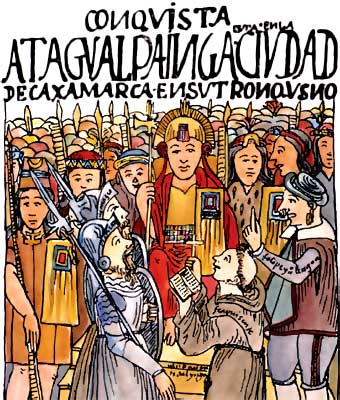
Explain: "Guaman Poma mirrors back to the Spanish
(in their language, which is alien to him) an image of
themselves that they often suppress, and will therefore surely
recognize" (35).
36:
What is transculturation? How does Poma engage in it?
Explain the significance of the spatial symbolism of the
three figures in the text.
37:
What does Pratt mean by "imagined communities" (37)?
38:
Explain: "In keeping with autonomous, fraternal
models of community, analyses of language use commonly assume
that principles of cooperation and shared understanding are
normally in effect" (38).
39:
Explain: "Internal social groups with histories and
lifeways different from the official ones began insisting on
those histories and lifeways as part of their
citizenship, as the very mode of their membership
in the national collectivity" (39).
40:
What does Pratt mean by "safe houses" (40)?
"Group" Discussion Questions:
What is the significance of the story about Pratt's son
and his baseball card collection? How does it illustrate
the points she makes in the rest of the essay? Refer to
specific statements in your response.
What are "the sociocultural complexities produced by
conquest and empire" (34)? How does Guaman Poma
exemplify those complexities? What other examples of
writers who do so can you identify?
Explain: "If one thinks of cultures, or
literatures, as discrete, coherently structured, monolingual
edifices, Guaman Poma's text, and indeed any autoethnographic
work, appears anomalous or chaotic. . . . If one does not
think of cultures this way, Guaman Poma's text is simply
heterogeneous" (36).
Explain: "Modern views of language as code and
competence assume a unified and homogeneous social world in
which language exists as a shared patrimony--as a device,
precisely, for imagining community" (38). Look
especially at "code," "competence," and "shared patrimony."
Explain: "If a classroom is analyzed as a social
world unified and homogenized with respect to the teacher,
whatever students do other than what the teacher specifies is
invisible or anomalous to the analysis" (38). How do the
sentiments in this quote relate to the rest of the
essay? How do power relations influence this situation?
In what ways can Morgan be identified as a "contact
zone"? In what way is it a "safe house"? Explain. Refer
to specific parts of Pratt's essay in your response.
Florentine
Codex (1547-79)
Which arts of the contact
zone, as discussed by Pratt, can be found in this work? Find
a specific example and explain which art it exemplifies.
1936:
In what ways can this text,
according the editors, be considered "the first work of
modern anthropology" (1936)?
1937:
How do Moctezuma's messengers
describe the Spaniards?
1938:
Who is Marina? What
purpose does she serve?
How does Moctezuma respond to
the news of the approaching Spanish?
1939:
Why do the Spanish attack the
Cholulans?
1940:
How, according to the
emissaries, are the Spaniards like monkeys and pigs?
1941:
Describe the interaction
between Moctezuma and Cortés.


 ?
?