

William Blake (1757-1827)
Songs of Innocence and Experience
Thoughts from the Longman Edition:
- "Songs is notable not only for a concern with the
different ways children and adults see and understand the
world (a theme that would occupy Wordsworth, too) but also for
its acid critiques of social evils, political injustice, and
their agents" (Longman 150).
- "Childhood is a time and a state of protected 'innocence,'
but it is a qualified innocence, not immune to the fallen
world and its institutions" (156).
- "Unlike Milton's narrative of the Fall from Paradise, Blake
shows either state of soul possible at any moment" (157).
- "Blake, like Mary Wollstonecraft, implicates innocence
with dangerous ignorance and vulnerability to oppression"
(157).
- "Blake's point is not that children are pure and adults
fallen, or that children are naive and adults
perspicacious. The contrary possibilities coexist, with
different plays and shades of emphasis in different poems"
(157).
Discussion Questions:
Norton Background:
46:
- Explain
the process of illuminated printing Blake employed.
- Describe
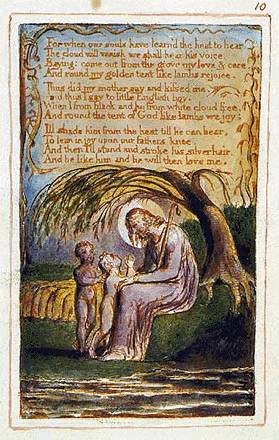
the relationship between word and image in Blake's poetry.
- Explain "I must Create a
System or be enslaved by another Man's" (46).
47-48:
- Explain
Blake's interpretations of the Fall of humanity.
"The Lamb"
52:
- In what
ways does this poem parallel catechistic religious
instruction?
- What does the Lamb represent?
"The Little Black Boy"
52-53:
- Summarize the message of the poem.
- Describe the use of black and white imagery in the poem.
"London"
62-63:
- What does "charter'd" mean (1)?
- What are "mind-forg'd manacles" (8)?
How does this image compare with the imagery found in lines
13-16 of "The Tyger"?
Other Discussion Questions:
45:
- Explain the significance of
Blake's altercation with John Schofield.
46:
- Explain the significance of
an "archaic native tradition" to Blake.
47:
- Explain Blake's use of irony.
- Explain Blake's views on the
French Revolution.
- Explain what Blake means by
the "Human Form Divine" (47).
"The Little Black Boy"
- Why is this song included
with the Songs of Innocence?
"London"
62:
- Why is this poem included with Songs of Experience?
- What is the "marriage hearse" (16)?
Another poem to consider:
"The Tyger"
58:
- What does Blake mean by "the forests of the night" (2)?
- Explain the imagery
used in lines 13-16.
- What is the speaker's answer
to the question in line 20?