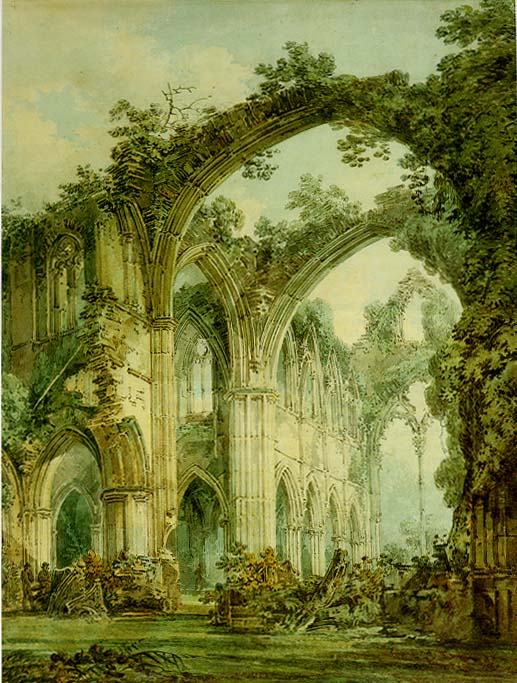
William Wordsworth (1770-1850) Samuel Taylor Coleridge (1772-1834) Lyrical Ballads
Things to Consider:
French Revolution and English counterrevolutionary
measures
Industrial Revolution and its Consequences
Use of Language
Choice of Subject
Discussion Questions:
William Wordsworth:
133:
Describe Wordsworth's view of the
French Revolution during its early stages.
Describe Wordsworth's relationship with Coleridge.
134:
Explain Wordsworth's concept of "spots of time."
Preface to Lyrical Ballads (1802):
144:
What is a lyrical ballad ?
145:
What is Wordsworth's purpose in writing this Preface?
146:
What does Wordsworth mean by "the language really used by
men" (146)?
147:
Explain: "All good poetry is
the spontaneous overflow of powerful feelings" (147).
What, according to Wordsworth, is a
poet? (See also 151)
155:
What exactly is "emotion
recollected in tranquility" (155)?
"Lines Written in Early Spring"
137:
In what ways does this poem
exemplify the ideas Wordsworth presents in his Preface?
Other Discussion
Questions:
146:
Why has Wordsworth selected scenes from "low and rustic
life" as his subject?
Explain: "In that condition the passions of men are
incorporated with the beautiful and permanent forms of nature"
(146).
147:
Explain: "From their rank in society and the
sameness and narrow circle of their intercourse, being less
under the influence of social vanity they convey their
feelings and notions in simple and unelaborated expressions"
(147).
How is the language of the lower ranks "more permanent"
and "far more philosophical" than that conventionally used by
poets?
What is a man "possessed of more than usual organic
sensibility" (147)?
Explain: "Our thoughts . . . are indeed the
representatives of our past feelings" (147).
Explain: "The feeling therein developed gives
importance to the action and situation and not the action and
situation to the feeling" (147).
149:
Why, according to Wordsworth, has he sought to avoid the
following devices?
personification of abstract ideas
poetic diction
falsehood of description
150:
What are "prosaisms"?
150-51:
Explain: "There neither is, nor can be, any
essential difference between the language of prose and
metrical composition" (150-51).
152:
If the language of real men is the absolute standard, why
would a poet need to modify it, as Wordsworth suggests?
What one restriction, according to Wordsworth, does the
poet face?
152-53:
Explain: "We have no sympathy but what is propagated
by pleasure" (152-53).
153:
Explain: "Poetry is the breath and finer spirit of
all knowledge" (153).
Explain: "The poet binds together by passion and
knowledge the vast empire of human society, as it is spread
over the whole earth, and over all time" (153).
154:
Explain: "Poetry is the first and last of all
knowledge--it is as immortal as the heart of man" (154).
Explain what Wordsworth says about differences in "kind"
and in "degree" (146).
155:
Why will "painful feeling . . . always be found
intermingled with powerful descriptions of the deeper
passions" (155)?
156:
Explain: "We not only wish to be pleased, but to be
pleased in that particular way in which we have been
accustomed to be pleased" (156).
"Lines
Written a Few Miles Above Tintern Abbey" Discussion Questions:
140:
What is the occasion for the composition of this
poem?
What is the origin of the "wreaths of smoke" Wordsworth
describes (17)?
141:
Explain lines 22-31.
What does it mean to become a "living soul" (46)?
What does it mean to "see into the life of things" (49)?
141-42:
Explain lines 65-84.
142:
Explain lines 93-102.
What is "the mighty world / Of eye,
and ear,--both what they half create, / And what perceive"
(105-7)?
143:
Explain: "In thy voice I
catch / The language of my former heart" (116-17).
Explain: "Nature never did
betray / The heart that loved her" (122-23).
What future does Wordsworth foresee
for his sister and her appreciation of nature? How does this
relate back to him?
Other Discussion Questions:
141:
Explain: "In this moment there is life and food /
For future years" (64-65).
Explain: "More like a man / Flying from something
he dreads, than one / Who sought the thing he loved" (70-72).
142:
Explain: "The sounding cataract / Haunted me like a
passion" (77-78).
Explain lines 78-83.
Why are all the "aching joys" (84) of the past all gone?
Explain lines 88-93.
"Ode: Intimations of Immortality" Discussion Questions: 188:
Explain: "I was often unable
to think of external things as having external existence,
and I communed with all that I saw as something not apart
from, but inherent in, my own immaterial nature" (188).
Poem Proper
How
does this poem compare with "Tintern Abbey"?
189:
Describe the rhyme scheme.
190:
What does “trailing clouds of glory”
(64) refer to? [cf.
Thomas Gray's "Elegy Written in a Country Churchyard": "The
paths of glory lead but to the grave" (36).]
What are “Shades of the
prison-house” (67)?
192:
What are “obstinate questionings/ Of
sense and outward things” (141-42)?
193:
What are “Thoughts that do often lie too deep for tears”
(203)?
cf. Romans 8.26 (RSV):
“Likewise the Spirit helps us in our weakness; for we
do not know how to pray as we ought, but the Spirit
himself intercedes for us with sighs too deep for words.”
(KJV): Likewise the Spirit also helpeth our
infirmities: for we know not what we should pray for as we
ought: but the Spirit itself maketh intercession for us
with groanings which cannot be uttered.