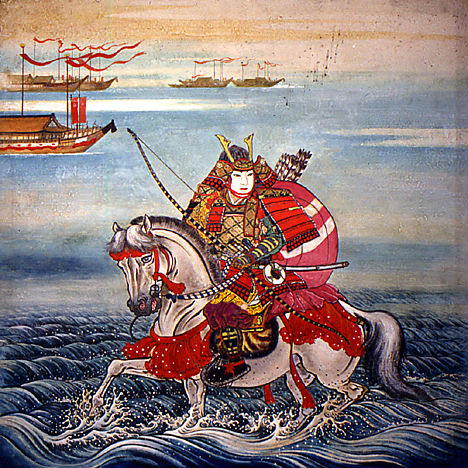
Atsumori |
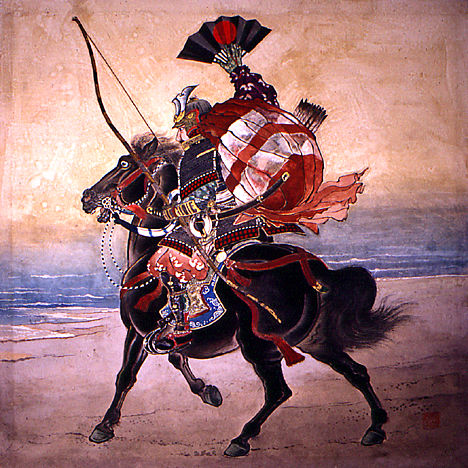
Naozane |
Noh Drama
- "The world's oldest extant professional theater" (Norton
[earlier edition] 2263).
- "When you feel ten in your heart, express seven in your
movements" (Norton [earlier edition] 2263).
Things To Consider:
- Portrayal of War
- Relationship between Gods and Humans
- Relationship between Chinese and Japanese
- Zen Buddhism
- yugen
- Chorus
- shite, waki, and tsure
Questions:
1494:
1495:
- Why does noh drama require such talent?
- What is the function of the chorus in a Noh play?
Zeami Motokiyo (1364-1443)
Atsumori
1496:
- Summarize the plot of this play.
- Who is Atsumori? Who is Rensho?
1497:
- Explain the song of the reapers.
1498:
- Why does one normally not hear reapers play flutes?
- How does this chorus compare with the one in Oedipus
Rex?
1499-1500:
- How does the description of the battle between the Taira
and Genji clans compare to that found in the Mahabharata?
1500:
- How does the fight between Atusmori and Naozane compare
with that between Achilles and Hector in the Iliad?
Other Discussion Questions:
1494:
- What is the significance of the fact that the actors are
all male?
- What is the "single and unvarying decoration for all Noh
plays" (1494)?
1501:
- Why has Atsumori "returned"?
1502:
- What is the symbol of changing seasons used to describe?
1503:
- Explain the final five lines. What change has taken
place?
Back to Top
