
John Keats (1795-1821)
Things to Consider:
- Negative Capability
- Role of Nature
- Role of Art
- Imagination
- Ode

- Apostrophe
** Homework Questions ** (See Part Two )
943-44:
- What, according to the editors, are
"the distinctive qualities of the work of Keats's maturity"
(943)?
Endymion: A Poetic Romance (1818)
947-48:
- How does the preface to this poem compare to Coleridge's
for "Kubla Khan"? Explain.
948:
- Explain: "[T]here is not a fiercer hell than the failure in
a great object" (948).
948-49:
- How does the speaker explain his motivation for telling the
story of Endymion?
948:
- Explain: "A thing of beauty is a joy
forever" (1).
- Where, according to the speaker, does one find happiness?
Letters
1009:
- What is "negative
capability"(1009)? See also 943.
1010-11:
- Explain Keats's three axioms of
poetry.
1013:
- What is the "egotistical sublime"
(1013)?
1017:
- Explain Keats's concept of the "vale of Soul-making"
(1017).
Other Discussion Questions:
942:
- Why did Keats abandon medicine for poetry?
950:
- Explain the reference to "self-destroying" (799).
- What, according to the speaker, comprises "the chief
intensity" (800)?
- Explain the reference to "men-slugs" and "human serpentry"
(821).
Part Two:
Homework Questions:
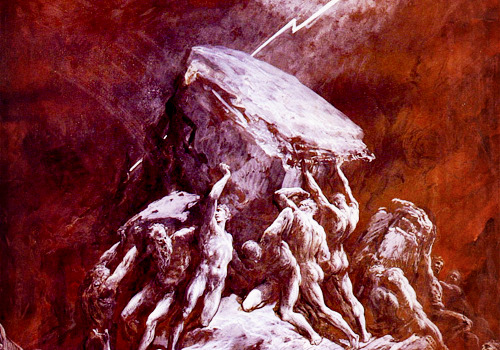
"The Fall of Hyperion: A Dream" (1819)
993:
- Why did Keats give up the Hyperion
project?
Canto One:
994:
- Explain the "induction" found in
the first 18 lines.
996:
- Explain the challenge the speaker is given in 1.107-8.
997:
- Why, according to Moneta, is the speaker alone (1.161ff)?
998:
- Explain the discussion of the vulture and the eagle
(1.191-92).
- What, according to Moneta, is the
difference between a poet and a dreamer?
999:
- What is an "immortal sickness" (1.258)?
1000:
- What is the "Omega of a wither'd
race" (1.288)?
1001:
- Explain the introduction that occurs in 1.349-53 of the
imagined quote that follows.
Canto Two:
1004:
- Explain Moneta's speech in 2.1-8.
Other Discussion Questions:
993:
- Who are Hyperion, Apollo, Mnemosyne, Saturn, and Moneta?
994:
- Explain: "That full draught is parent of my theme" (1.6).
- Describe the imagery presented in the speaker's vision in
1.59-92.
999:
- Explain 1.243-48.
- Describe Moneta's face in 1.256-71.
1001:
- What is the relationship in this poem between Moneta and
Mnemosyne? (See footnote 3.)
- Who is Thea? Why does she wake Saturn (1.354ff)?
1002:
- What literary technique is being employed in 1.372-81?
Explain. (See also 1.404-8.)
- For how long does the speaker stay looking at the three
motionless figures of Moneta, Thea, and Saturn
(1.388-93)? Why?
1002-3:
- Summarize Saturn's speech in 1.412-38.
1003:
1004:
- What Titan remains in power at this point? Why?
Other Poems to Consider:
"Ode to a Nightingale" (1819)
- How does this poem compare with Percy Shelley's "To a
Skylark"?
969:
- What is hemlock (2)? Why does the speaker feel as
if he has drunk it?
- What is Lethe (4)?
- What does the speaker long to forget?
- What is vintage (11)?
- What is the "blushful Hippocrene" (16)?
970:
- Why "seems it rich to die" (55)?
- Who is Ruth (66)?

971:
- Explain: "The fancy cannot cheat so well / As she is
fam'd to do" (73-4).


"Ode on a Grecian Urn" (1819)
- How does "Ode on a Grecian Urn" compare to Shakespeare's
Sonnet #18?
971:
- Why are unheard melodies sweeter than heard ones (11-12)?
972:
- Explain: "She cannot fade, though thou hast not thy
bliss, / For ever wilt thou love and she be fair" (19-20).
- Explain: "Beauty is truth, truth beauty,--that is all
/ Ye know on earth, and all ye need to know" (49-50).
More Complex Questions:
(Source: McGraw-Hill Guide to English Literature,
vol. 2)
- Why does the speaker say that the urn "canst thus express
/ A flowery tale more sweetly than our rhyme" (3-4)?
Explain what this means and how it might be so.
- This poem is an apostrophe to an inanimate object.
How does this rhetorical device function in this poem?
- In the ode, the speaker establishes a contrast between
life as it is represented on the urn and life as it is
lived. What is the nature of this contrast, and where
does it surface in this poem?
Back to Top